Mari is open source
Eric Disque · 2026-08-11
Mari is a self-hosted product knowledge platform. It pulls the places your team's knowledge actually lives, repos, Slack threads, wikis, and tickets, into one searchable knowledge base. Then it holds every sentence in it accountable: who owns this, where did it come from, and is it still true. As of today it's open source under Apache 2.0.
We've written before about why we built it. The short version: docs fail silently, and the one person who knows types the correction into a thread where it dies by lunch. Meanwhile AI agents read your docs as ground truth without the ability to smell staleness. Search was never the missing piece. Accountability was.
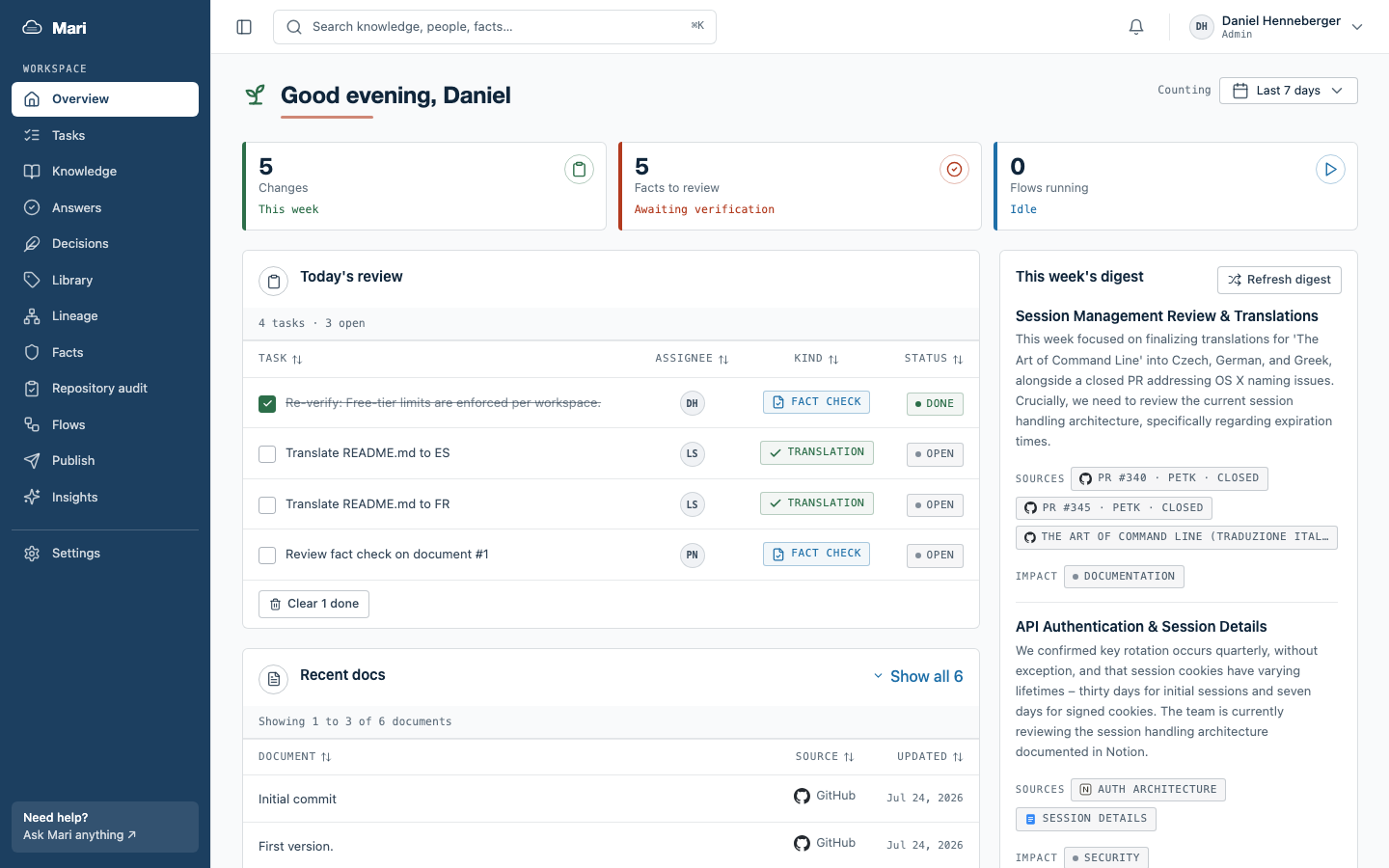
What you get
- A dozen connectors feeding one ingestion pipeline: GitHub (files, commits, PR descriptions, issues, and comments), Slack, Google Drive, Confluence, Notion, Jira, Airtable, Asana, Dropbox, Linear, Trello, and Zendesk. Unchanged content is never re-embedded, so a no-op resync takes seconds.
- Answers with receipts. Ask a question and the answer streams with numbered citations back to the document, commit, or thread it came from.
- Facts with owners. A fact in Mari has a source, an owner, a verification status, and a freshness date. A sentence someone signed.
- A lineage graph tying documents, commits, PRs, and decisions together, so "what changed, and what did that break?" is a query, not an archaeology project.
- A repo audit that scans connected repos for documentation drift and offers one-click fixes.
- Destinations for putting the record where people ask: a knowledge chat, MCP servers your agents can read, a Slack bot that answers when you @mention it, and a GitHub bot that checks a pull request against what's known.
Run it
git clone --recurse-submodules https://github.com/MariHQ/mari && cd mari
cp .env.example .env
docker compose up --build
First run prints a one-time setup token. Redeem it at localhost:8080, and the onboarding wizard takes it from there. Everything runs on your infrastructure: Postgres with pgvector for storage and search, and local models through ollama if you want the LLM features. Without ollama the product still works, it just falls back to keyword search and deterministic behavior. Degraded, never broken.
The full walkthrough, with what each step actually looks like, is in Zero to knowledge base in 10 minutes.
The licenses
Mari is Apache 2.0, with an explicit patent grant. Use it, modify it, redistribute it, commercially included. A lightweight CLA covers contributions: you keep your copyright, and signing your commits off (git commit -s) is the agreement. Nothing to mail in, no bot.
See it live
If you'd rather watch than clone, book a demo. If you'd rather read code, the repo is open. Issues and PRs welcome.
Eric